
Summary
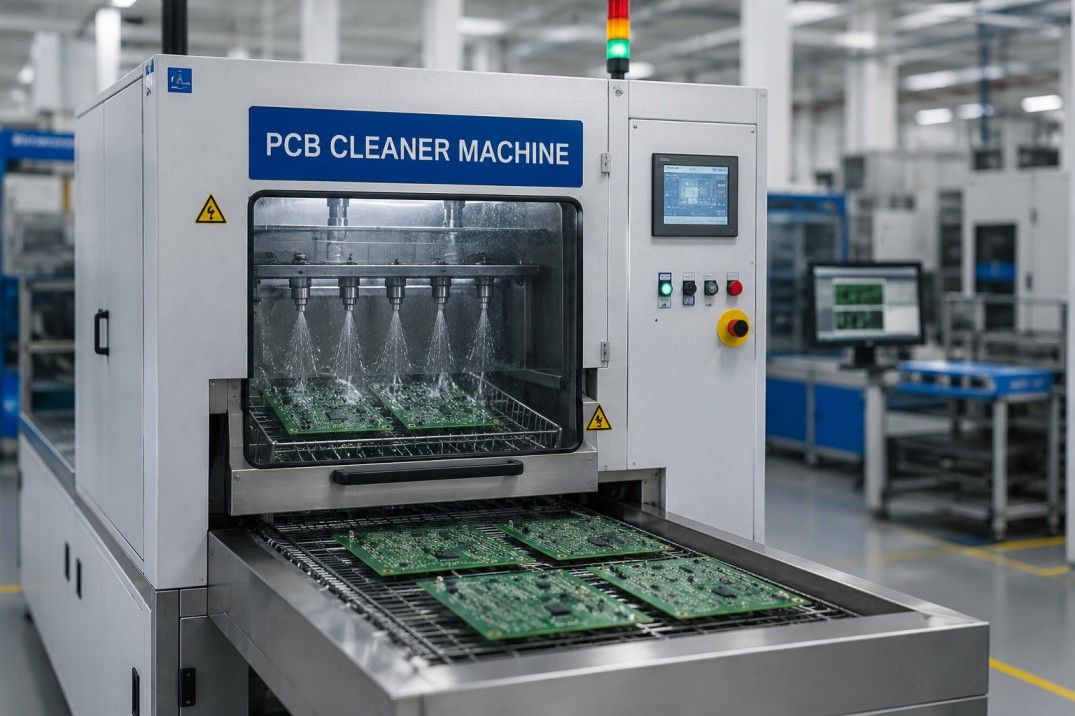
A PCB cleaner machine is industrial equipment used to remove flux residue, solder paste, dust, oil, and ionic contaminants from printed circuit boards after assembly or rework. The most effective type is the PCB ultrasonic cleaning machine, which uses high-frequency sound waves to create microscopic cavitation bubbles that lift contaminants from tight components, connector pins, and under-board gaps without damaging delicate electronics. PCB cleaning improves reliability, prevents corrosion, and reduces field failures in finished electronic assemblies.
What is a PCB Cleaner Machine?
A PCB cleaner machine is designed specifically to clean printed circuit boards (PCBs) after soldering, wave soldering, reflow, or rework processes. During manufacturing, boards pick up:
- Flux residue from soldering
- Rosin and adhesive traces
- Dust and metal particles
- Oil and fingerprint contamination
- Ionic residues that cause corrosion or short circuits
If left uncleaned, these contaminants can cause electrical leakage, dendritic growth, corrosion, and premature board failure—issues that are costly to trace once a product is in the field. This is why electronics manufacturers, repair centers, and EMS (Electronics Manufacturing Services) providers rely on dedicated PCB cleaning equipment rather than manual wiping or solvent spraying alone.
How Does an Ultrasonic PCB Cleaner Machine Work?
An ultrasonic PCB cleaner machine uses transducers to convert electrical energy into high-frequency sound waves, typically between 25 kHz and 80 kHz. These waves travel through a cleaning solution and create millions of tiny vacuum bubbles in a process called cavitation.
The Cleaning Process, Step by Step
- Immersion – The PCB is placed in a basket and lowered into the cleaning tank, which is filled with a water-based or specialized PCB cleaning chemical.
- Cavitation – Ultrasonic transducers generate sound waves that form microscopic bubbles in the liquid.
- Implosion – These bubbles collapse against the board's surface, releasing tiny bursts of energy that dislodge flux, dust, and particulate residue, even from under components and inside connector gaps.
- Rinsing – In multi-stage systems, the board moves to a rinse tank to remove any leftover cleaning agent.
- Drying – Hot air or vacuum drying removes moisture before the board moves on to inspection or packaging.
This non-contact cleaning method is what makes ultrasonic technology ideal for PCBs. It reaches places that brushes and sprays cannot, without applying mechanical stress to sensitive solder joints or fine-pitch components.
Why PCB Cleaning Matters in Electronics Manufacturing
1. Prevents Long-Term Reliability Failures
Flux residue is mildly corrosive over time. If it is not removed, it can lead to leakage current, short circuits, or signal interference, especially in high-density and high-reliability boards used in automotive, medical, and aerospace electronics.
2. Improves Conformal Coating Adhesion
Boards that receive a conformal coating after assembly need a contaminant-free surface. Residual flux or oils reduce coating adhesion, which can lead to coating failure and moisture ingress later.
3. Supports No-Clean and Water-Soluble Flux Removal
While "no-clean" fluxes are common, many high-reliability and RF/microwave boards still require thorough cleaning to meet strict ionic cleanliness standards, commonly tested in line with IPC standards for ionic contamination.
4. Reduces Rework and Field Returns
Clean boards test more accurately during inline AOI and ICT inspection. Removing residues before inspection minimizes false failures and reduces costly rework cycles.
5. Extends Component Lifespan
Particularly for connectors, relays, and exposed metal contacts, ultrasonic cleaning removes oxidation-causing residues that would otherwise shorten component life.
PCB Ultrasonic Cleaning Machine vs. Manual Cleaning
For production environments handling dozens or hundreds of boards daily, an ultrasonic PCB cleaner machine is far more scalable and consistent than manual wiping or aerosol spray cleaning.
Types of PCB Cleaning Machines
- Single-Stage Ultrasonic PCB Cleaner – Suited for low- to medium-volume cleaning and rework labs.
- Multi-Stage Aqueous Ultrasonic Cleaning System – Combines wash, rinse, and drying stages for higher-volume production lines.
- Inline/Automated Ultrasonic Cleaners – Integrated into SMT or assembly lines for continuous processing.
Hisashi Industries designs customized PCB cleaning machines, including single-stage and multi-stage ultrasonic systems, tailored to board size, contamination type, and daily production volume. This approach is especially useful for EMS units and electronics manufacturers with specific cleanliness requirements.
Choosing the Right PCB Cleaner Machine
When selecting a machine, evaluate the following:
- Board size and batch volume – Determines tank dimensions and basket capacity.
- Contaminant type – Rosin flux, water-soluble flux, and oil-based residues may each require a different chemical formulation.
- Frequency requirement – Higher frequencies (68–80 kHz) suit delicate, fine-pitch boards, while lower frequencies handle heavier contamination.
- Number of stages – Single-stage systems work for simple cleaning, while multi-stage systems offer wash-rinse-dry automation.
- Drying method – Hot air or vacuum drying prevents moisture-related defects before further processing.
FAQs
1. What is the best frequency for ultrasonic PCB cleaning?
Frequencies between 40 kHz and 80 kHz are generally preferred for PCBs. Higher frequencies produce gentler, finer cavitation suited to dense, fine-pitch components, while lower frequencies are better at removing heavier flux residue.
2. Can ultrasonic cleaning damage electronic components?
When used correctly, with the right frequency, cleaning solution, and processing time, ultrasonic cleaning is safe for most PCBs. It is a non-contact process, which actually reduces risk compared with manual brushing.
3. Is ultrasonic PCB cleaning suitable for assembled boards with sensitive components?
Yes, but cleaning parameters should be adjusted for boards with sealed relays, microphones, or unsealed connectors. It is recommended to consult the machine manufacturer for component-specific settings.
4. What cleaning solution is used in a PCB ultrasonic cleaner machine?
Most systems use water-based, saponifier, or specialized PCB cleaning chemicals designed to dissolve flux and rosin without leaving residue. The right chemical depends on the type of flux used during soldering.
5. How long does ultrasonic PCB cleaning take?
Typical cleaning cycles range from 3 to 10 minutes per batch, depending on the contamination level, board density, and the number of stages (wash, rinse, dry) in the system.
Conclusion
A PCB cleaner machine, particularly an ultrasonic-based system, is essential for maintaining the reliability, longevity, and performance of printed circuit boards. By using cavitation-driven cleaning instead of manual or contact-based methods, manufacturers can:
- Remove flux, oil, and ionic residues effectively
- Reduce field failures and rework costs
- Improve conformal coating adhesion
- Process boards faster and more consistently
- Meet high-reliability cleanliness standards
As electronics continue moving toward smaller, denser, and more sensitive designs, investing in a properly specified PCB ultrasonic cleaning machine is no longer optional. It is now a core part of quality assurance in modern electronics manufacturing.
Contact Us
Looking for a reliable PCB Cleaner Machine or a customized PCB Ultrasonic Cleaning Machine for your production line? Hisashi Industries has over 25 years of experience designing precision ultrasonic cleaning systems for the electronics, medical, and automotive industries. Get in touch today.
Call us: +91 9871013815
Email: [email protected]
Visit: hisashiultrasonic.com
Request a free cleaning trial or get a customized quote for your PCB cleaning requirement today.
#PCBCleanerMachine #UltrasonicPCBCleaner #PCBUltrasonicCleaningMachine #ElectronicsManufacturing #PCBCleaning #FluxRemoval #SMTCleaning #IndustrialCleaningSolutions #HisashiIndustries #PrecisionCleaning #EMSManufacturing #PCBAssembly